Venice is 118 islands, 400 bridges and no roads at all — a city built on wooden piles in a lagoon, where the taxis are boats, the post arrives by boat and the best way to see anything is to get lost on foot. It is also far more than the three streets around St Mark's Square: the real Venice is in Cannaregio, Dorsoduro and Castello, where people still shop at the market and lean out of windows to talk to each other across a canal.
This Venice travel guide ranks the best places to visit in Venice, explains how to see the Basilica, the Doge's Palace and the Grand Canal without spending your day in queues, and covers the practical side of the trip: the best time to visit Venice, where to stay, how to get around, and how to book flights to Venice, a hotel on the right side of the canal, a car for the mainland, an Italy eSIM and the Venice tours and island trips worth reserving before you fly.
Why Venice Belongs on Every Travel List
There is nowhere else like it. Venice is a city with no cars, a thousand years of maritime power in its palaces, and art by Titian, Tintoretto and Veronese still hanging in the churches they painted for. Even with the crowds, off the main corridor it is still the most atmospheric city in Europe.
A City Built on Water
Canals instead of roads, bridges instead of crossings, and palaces rising straight out of the lagoon — Venice is a piece of engineering that has been working for 1,400 years and looks like nothing else on earth.
Art in Its Original Setting
St Mark's golden mosaics, the Doge's Palace with Tintoretto's Paradiso, the Accademia's Venetian paintings and the Guggenheim's modern collection all sit within a short walk of each other.
Cicchetti and Lagoon Seafood
Venice eats at the bar: small plates of baccalà mantecato, sarde in saor and fried calamari with an ombra of white wine, followed by risotto al nero di seppia or spider crab in a canal-side trattoria.
Romance Without Trying
Early morning on a deserted bridge, a traghetto across the Grand Canal, the light on the water at sunset — Venice does the most romantic moments in Europe without any effort at all.
Seasons of Their Own
Carnival in February, spring light in April and May, the Film Festival and warm lagoon evenings in late summer, and misty, quiet November days that feel like a painting.
Easy to Reach, Easy to Leave
Trains cross the causeway straight into Santa Lucia station, the airport is 20 minutes away by water bus, and Padua, Verona, Vicenza and the Dolomites are all simple day trips.
The Best Places to Visit in Venice
These eight places cover the Venice of the postcards and the Venice that locals still live in — the basilica, the palace, the canals, the islands and the quieter sestieri where the city feels like itself.
St Mark's Square & Basilica
The Ceremonial Heart
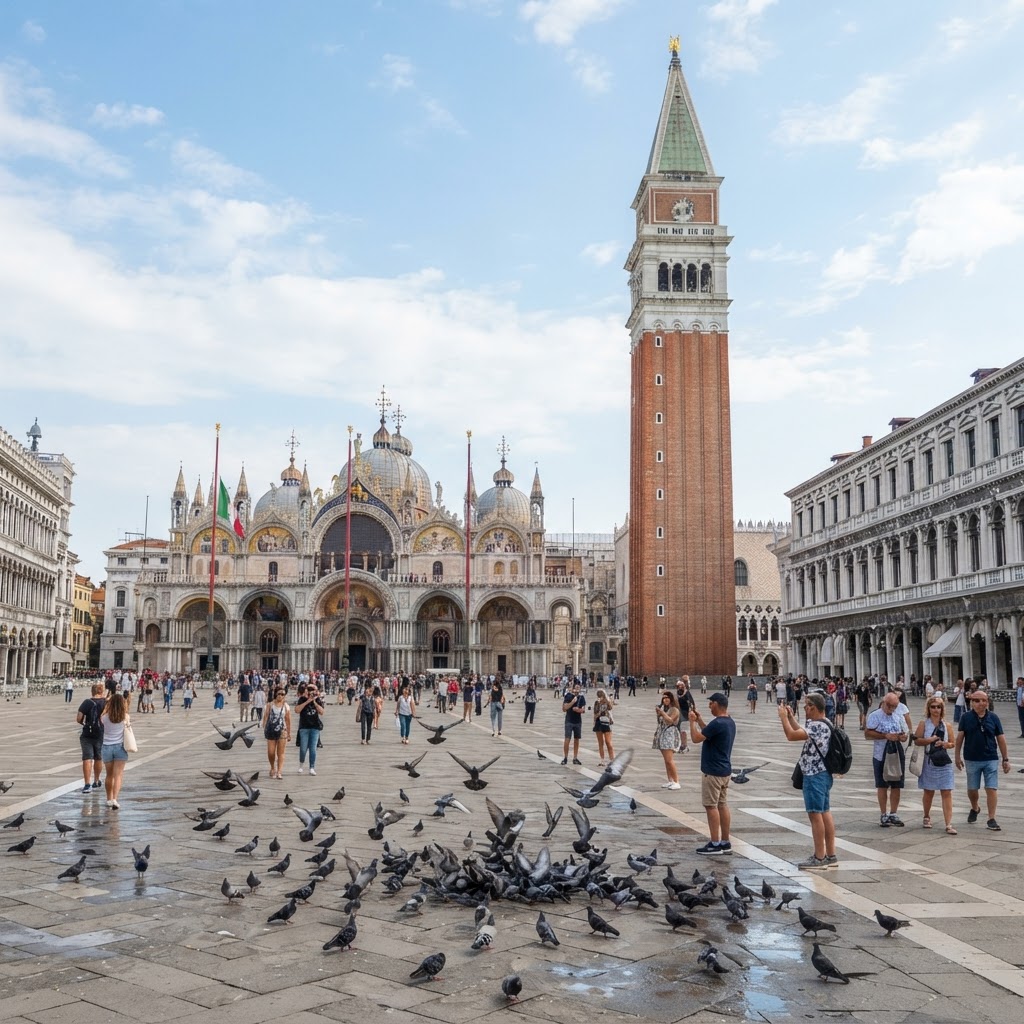
Piazza San Marco is the most beautiful drawing room in Europe: the basilica with its golden mosaics, the campanile, the clock tower and the long arcades of the Procuratie. Enter the basilica early with a timed ticket (it is free but the line is not), take the terrace view over the square, then climb the campanile for the lagoon panorama. Come back at night, when the orchestras play under the arcades and the square is nearly empty.
The Doge's Palace & the Bridge of Sighs
A Thousand Years of Power
The Doge's Palace is two buildings in one: a Gothic filigree facade facing the lagoon and the huge Chamber of the Great Council inside, with Tintoretto's Paradiso filling an entire wall. Take the secret itineraries tour to cross the Bridge of Sighs into the prisons, book the first entry slot of the day, and combine the ticket with the Correr Museum on the other side of the square.
The Grand Canal
Venice's Main Street
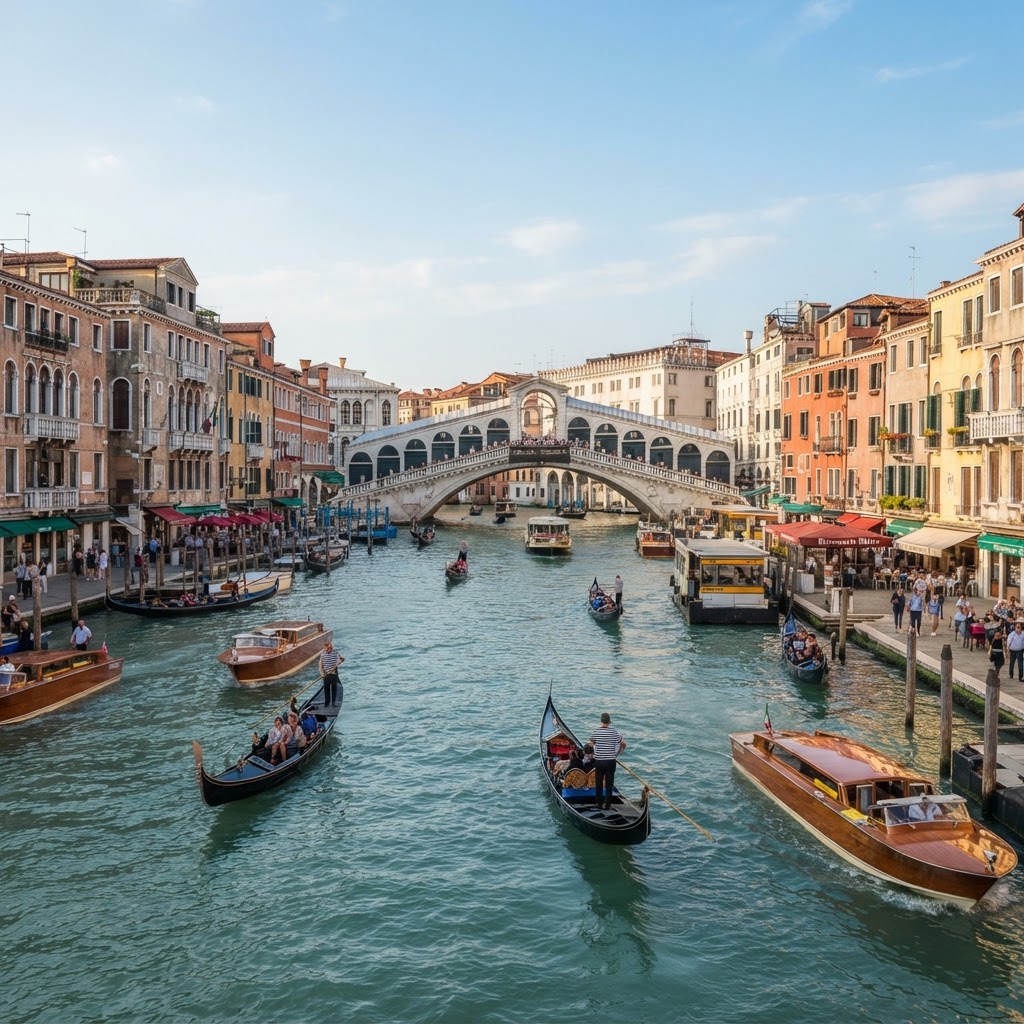
The Grand Canal is the city's high street, and you should see it three ways: on the line 1 vaporetto from San Zaccaria to Piazzale Roma, standing at the back for the palaces and the Rialto bridge; on a gondola or water taxi for the smaller side canals; and on a traghetto, the two-euro gondola ferry that crosses the canal where there is no bridge. Aim for an hour before sunset, when the facades turn gold.
The Rialto Bridge & Market
Shopping & the Old Trading City
The Rialto is where Venice made its money: the market on this side of the bridge sells lagoon fish, vegetables from the mainland and fruit from the islands, and it is at its best before nine in the morning. Cross the bridge for the view down the Grand Canal, then escape the souvenir crush into the Erbaria and San Polo lanes, where the bacari serve wine and cicchetti from mid-morning.
Dorsoduro & the Accademia
Art, Squares & Student Life
Dorsoduro is the Venice of wide quays, student cafés and the best museums: the Gallerie dell'Accademia for Venetian painting from Bellini to Titian, the Peggy Guggenheim Collection in her canal-side palazzo, and the Salute church, built as a plague thanksgiving, at the tip of the point. Campo Santa Margherita is the liveliest square in the city after dark.
Cannaregio & the Jewish Ghetto
The Venice People Live In
Cannaregio is the largest residential sestiere, and the walk along the Fondamenta della Misericordia and the Fondamenta dei Ormesini is the best evening in Venice — canal-side bars, no crowds, and locals playing cards in the campos. The Jewish Ghetto, established in 1516 and the origin of the word, has a moving museum and synagogue tours, and the nearby Strada Nova leads back towards the station.
Murano, Burano & the Lagoon Islands
Glass, Colour & Island Time
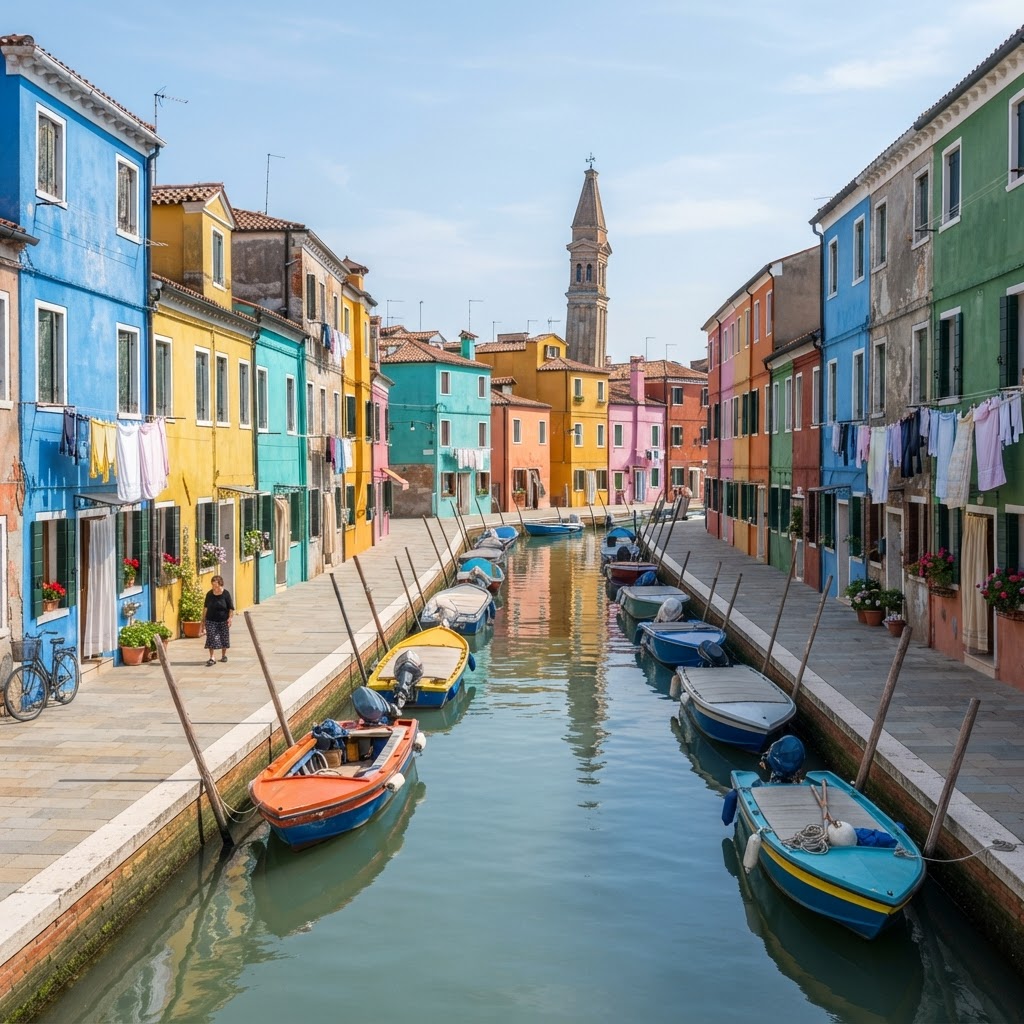
The lagoon islands are the best half-day out of Venice. Murano is the glass island, with furnaces and showrooms still working the craft that Venice protected for centuries; Burano is a fishing village of painted houses and lace, with the most photographed streets in the lagoon; Torcello is the quietest, holding a Byzantine basilica with a mosaic apse worth the trip alone. Take the vaporetto line 12 from Fondamente Nove and go early.
San Giorgio Maggiore & Giudecca
The Best View of Venice
San Giorgio Maggiore sits on its own island across the water from the Piazzetta, and the lift up its campanile gives the definitive view of Venice: St Mark's, the Doge's Palace, the whole basin and the lagoon beyond. Cross on the number 2 vaporetto, climb, then take the Zitelle stop over to Giudecca for the Zattere waterfront, the Redentore church and a long, cheap lunch with the best skyline in the city in front of you.
When to Visit Venice
April to June and September to early November are the best months: warm but not hot, long light, and a lagoon at its most beautiful. May and late September are the sweet spot, with the film festival in early September adding a buzz without the peak-season crush. July and August are hot and extremely busy, and the mosquitoes in the lagoon islands are at their worst.
Winter is Venice at its most cinematic: cold, foggy, quiet and cheap, with Carnival in February filling the city with masks and music. Acqua alta — the seasonal high water — peaks between October and December, but the raised walkways and the MOSE barrier deal with most of it, and hotels and restaurants are half the price. Book spring and autumn trips three to four months ahead.
Getting Around Venice
Venice has no cars, so your choices are feet, vaporetto and boat. Walking is the real way to see the city — the whole of Venice is only four kilometres across and every sestiere is connected by bridges — so plan each day as one loop rather than a series of boat hops. The vaporetto (line 1 and 2 along the Grand Canal, 4, 5 and 12 out to the islands) works on a multi-day pass, which pays for itself quickly; validate tickets at the turnstile before every boarding.
From Marco Polo airport, the Alilaguna water bus takes about an hour to St Mark's, a water taxi takes 25 minutes for a fixed price, and the bus to Piazzale Roma plus a vaporetto is the cheapest route. Trains arrive at Santa Lucia station on the Grand Canal itself. A rental car is only useful for leaving the lagoon — the Veneto, the Dolomites, Verona and Padua — and should be collected from Mestre or the airport, never driven into Venice.
Flights to Venice
Venice is served by Marco Polo airport (VCE), 20 minutes from the city by water bus, water taxi or bus, and by Treviso (TSF) for many low-cost routes, 40 minutes away by shuttle. Direct flights reach Venice from London, Paris, Amsterdam, Frankfurt, Munich, Zurich, Dubai, Doha, New York and most European hubs, with ITA Airways, Emirates, easyJet, Ryanair, British Airways and Lufthansa among the airlines serving it.
Fares are lowest in late autumn and early winter and on weekday departures, while May, June and September are the peak. Compare live prices for your dates below, and remember to add the water transfer into your budget — the Alilaguna is the cheapest way to arrive by water.
Where to Stay in Venice
Where you sleep changes the whole trip. For a first visit, Cannaregio near the station and the Fondamente Nove is the best balance of charm, value and easy luggage; Castello is quiet and close to St Mark's; Dorsoduro is the most local and student-friendly; San Marco and San Polo are the most central and expensive. Staying on Giudecca or near the Zattere gives you a short boat ride and a much calmer night.
Book early for Carnival, the Biennale opening and the film festival, and check the exact vaporetto stop before you book — in Venice, a hotel "near St Mark's" can still mean a 20-minute walk with a suitcase over three bridges.
Find Venice Hotels
Compare hotels, apartments and boutique stays across the city, with free cancellation on most rooms and filters for neighbourhood, price and rating.
Book Venice HotelsCar Hire for Day Trips from Venice
Cars cannot enter Venice, and the only place to leave one is a garage in Piazzale Roma or Mestre, so renting a car makes sense only if you plan to leave the lagoon. That is worth doing: the Veneto has Verona, Padua, Vicenza and the Palladian villas, the Prosecco hills around Valdobbiadene, and the Dolomites two hours north. Collect on the mainland on the day you depart and drop it back before your train.
Stay Connected with an Italy eSIM
Install an Italy eSIM before you fly and you land with Google Maps, train tickets, museum reservations and translation apps already working. No roaming charges, no hunting for a SIM shop at the airport, and your normal number stays active for calls.
Get an Italy eSIMRent a Bike in Venice
A bike is the quickest way to cover a lot of ground without queueing for buses or walking the same street twice. Rent one for a morning, ride the quietest lanes and riverside paths, and use it to link the sights that sit just outside the historic centre.
Rent a BikeThings to Do in Venice: Tours Worth Booking
Venice is the city where a tour genuinely beats going alone: a skip-the-line entry and guide for St Mark's Basilica and the Doge's Palace makes sense of a thousand years of history in two hours, a morning Rialto market and cicchetti walk gets you into the bars you would otherwise walk past, and a small-group gondola or lagoon island trip solves the logistics of the water. Book these before you travel, especially for Carnival and the summer months.
Venice: St Mark's Basilica and Doge's Palace skip-the-line ticketsPractical Tips for Your Venice Trip
When to visit Venice
April to June and September to early November are the best months, with mild weather and the lagoon at its best. Winter is cheap, quiet and atmospheric but cold and prone to acqua alta, while July and August are hot, humid and the busiest of the year.
How many days you need
Three full days is right for a first visit: one for St Mark's, the Doge's Palace and the Grand Canal, one for Dorsoduro, the Accademia and the Salute, and one for Cannaregio, the Rialto market and a cicchetti crawl. Add a fourth day for Murano, Burano and Torcello.
Book the Basilica and Doge's Palace ahead
St Mark's Basilica is free but the queue is long, and the Doge's Palace, the campanile and the Accademia all use timed entry. Reserve skip-the-line tickets or guided entries two to four weeks ahead in spring and autumn, and take the Palazzo Ducale secret itineraries tour if you want the Bridge of Sighs from inside.
Walk one loop a day, not point to point
Venice punishes backtracking. Plan each day as a circle through one or two sestieri, use the traghetto ferries to cross the Grand Canal for a couple of euros, and treat getting lost in the calli as part of the itinerary rather than a failure of navigation.
Practical details worth knowing
There is a day-tripper access fee on peak dates, so check before you arrive and register if it applies. Carry a refillable bottle for the fountains, dress for churches, keep luggage light for the bridges, and never sit on a bridge with your feet dangling or picnic on the steps — both are fined.
Eat and drink like a Venetian
Stand at the bar for coffee and cicchetti, order the lagoon fish rather than the pizza, and eat in Cannaregio, Dorsoduro or Castello rather than within sight of St Mark's. Book dinner for 8pm, and try a spritz with Select — the Venetian original — at a canal-side bacaro before you eat.
Frequently Asked Questions
What are the best places to visit in Venice for first-timers?
See St Mark's Square and Basilica, the Doge's Palace and the Bridge of Sighs, ride the Grand Canal on the number 1 vaporetto, cross the Rialto Bridge and visit the market, then explore Dorsoduro and the Accademia, wander Cannaregio in the evening, and take the lift up San Giorgio Maggiore's campanile for the best view of the city. Add Murano and Burano if you have a fourth day.
How many days do you need in Venice?
Three full days covers the main sights and one island trip at a comfortable pace. Two days is enough for St Mark's, the Doge's Palace, the Grand Canal and the Rialto, while four or five days lets you add the Accademia, the Guggenheim, the lagoon islands and a day trip to Padua or Verona.
When is the best time to visit Venice?
April to June and September to early November are the best months, with warm weather and manageable crowds. Winter is quiet, cheap and atmospheric but cold, with acqua alta most likely between October and December, while July and August are hot, humid and at their busiest.
How do you get around Venice?
On foot and by vaporetto. The historic city is compact and crossed by bridges, so walking is the main way around, with water buses for longer hops and the islands, traghetto ferries to cross the Grand Canal, and water taxis for arrivals with luggage. Cars cannot enter the city.
Where should I stay in Venice for a first visit?
Cannaregio is the best balance of charm, value and access from the station, Castello is quiet and close to St Mark's, and Dorsoduro is the most local. San Marco and San Polo are the most central and the most expensive, and Giudecca offers calm with a short boat ride into the centre.
Do I need to book Venice attractions in advance?
Yes for the Doge's Palace, the campanile, the Accademia and the Guggenheim, all of which use timed entry and sell out in spring and autumn. St Mark's Basilica is free but has a long queue, so a timed entry or guided visit is worth the small fee. Book gondola and island tours ahead in summer and during Carnival.
Final Tips for Visiting Venice
The trick with Venice is to move against the flow. Do the headline sights at opening time, then spend the middle of the day in Cannaregio, Castello or Dorsoduro where the streets are quiet and the bacari are full of people who live there. Stay out after 9pm, when the day-trippers have gone and the city is lit by lamps on the water, and Venice stops being a museum and becomes a place again.
With flights to Venice booked for spring or autumn, a hotel in Cannaregio or Dorsoduro, water transfers planned from the airport, an Italy eSIM active before you land and your Basilica, Doge's Palace and island tours reserved, all that is left is the first vaporetto ride down the Grand Canal. Use the booking tools on this page to arrange the whole trip in one place.
Plan Your Venice Trip Today
Compare live flights to Venice, book a hotel in the sestiere that suits you, arrange your water transfer and island trips, set up an Italy eSIM and lock in skip-the-line entry to St Mark's Basilica and the Doge's Palace — all in one place, before you fly.
Keep Exploring
Best Places to Visit in Florence
The Renaissance in one walkable city, two hours by high-speed train.
Best Places to Visit in Milan
The Duomo, the Last Supper and the Navigli, two and a half hours away.
Best Places to Visit in Bologna
Porticoes, towers and the best food in Italy, under two hours by train.
Where to Buy Airline Tickets
Where to find the cheapest airfares, which booking sites are worth using and when to book.