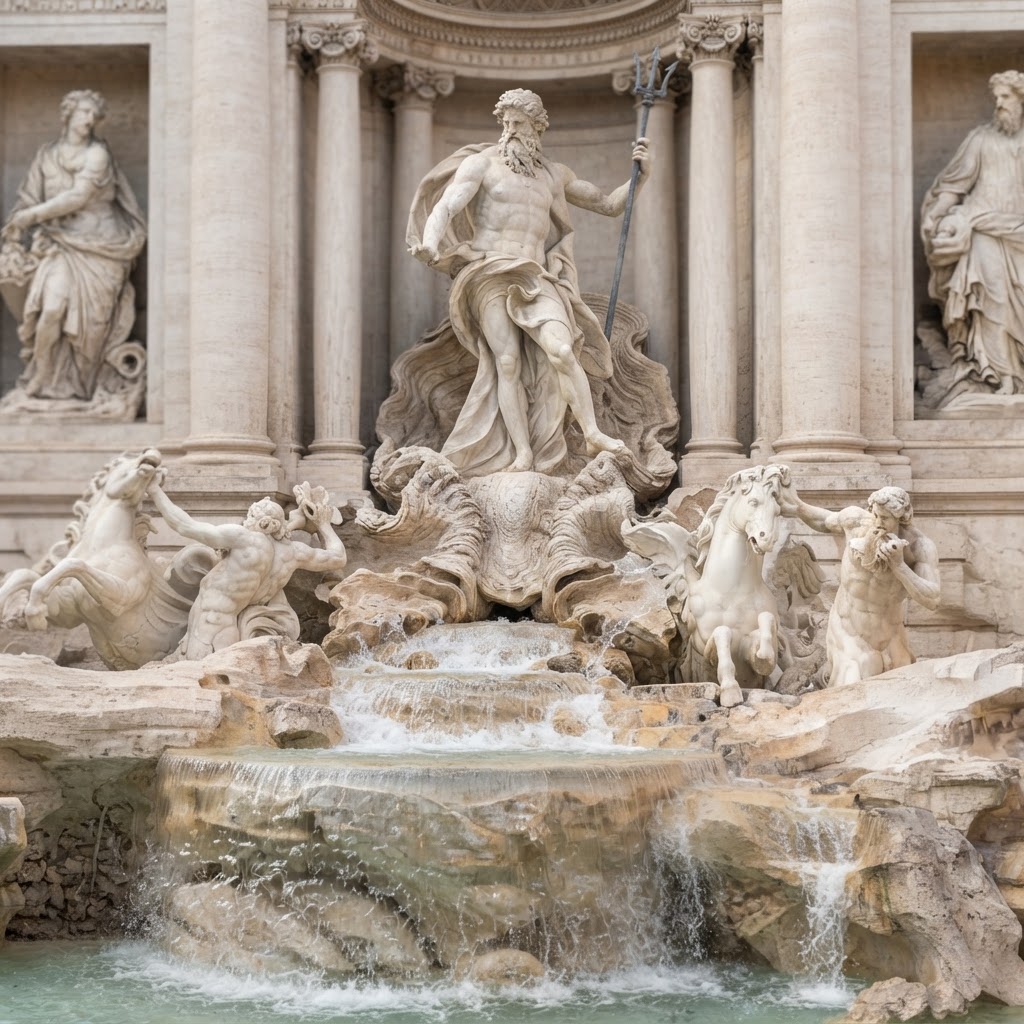
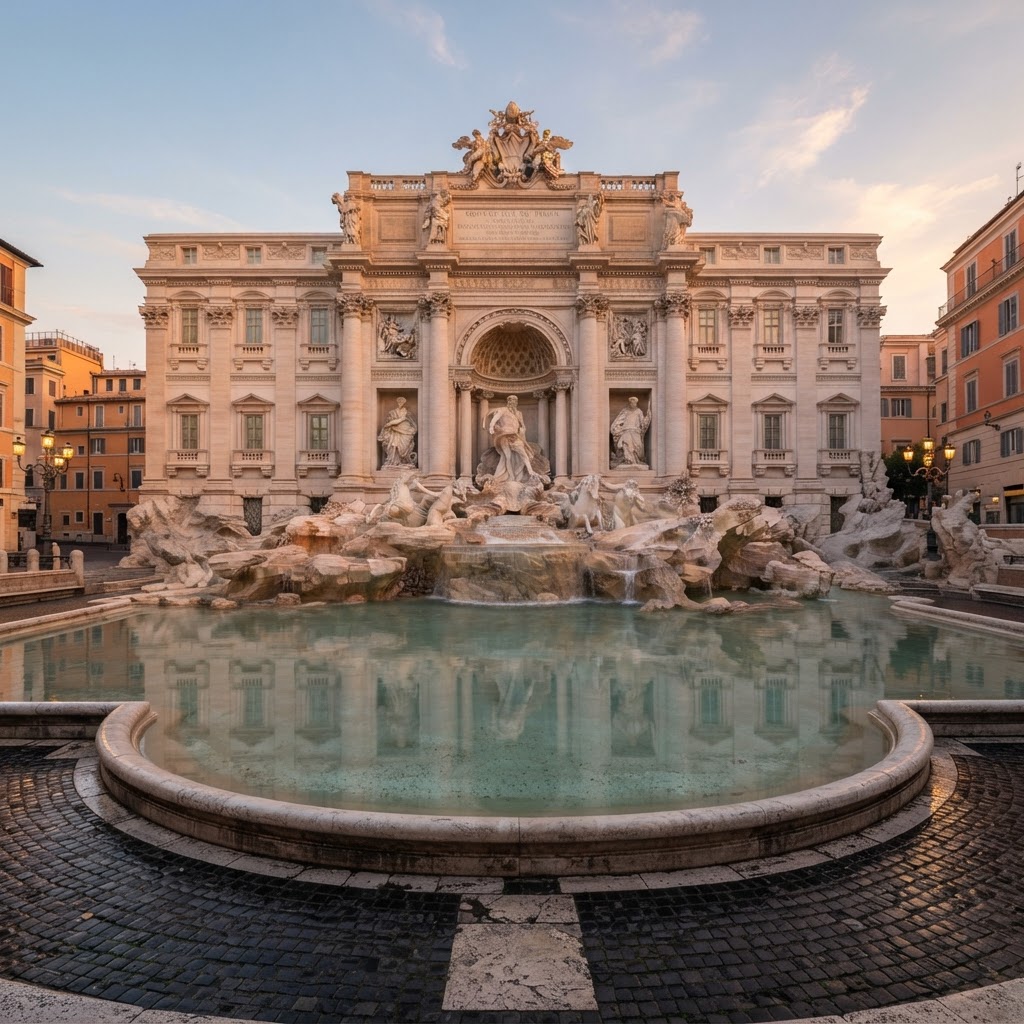
The Fontana di Trevi, the Trevi Fountain, is the largest and most spectacular baroque fountain in Rome, and one of the most famous landmarks in the world. Built into the rear wall of the Palazzo Poli in the heart of the historic centre, it depicts Oceanus, god of all waters, standing in a shell chariot pulled by seahorses and guided by Tritons, with water cascading from every ledge and niche into a great pool at its feet. For nearly three centuries it has drawn travellers, pilgrims and film-makers to its small piazza, all of them tossing a coin over their shoulder in the hope of one day returning to the Eternal City.
This complete guide to the Trevi Fountain in Rome covers everything you need to plan your visit: the legend of the coin toss, the best time to go, how to get there and what to see. We walk through the history of the fountain, from the ancient Acqua Vergine aqueduct that feeds it to Nicola Salvi's baroque masterpiece, and answer the questions first-time visitors ask most. We also bring together all the travel essentials in one place: live flight prices to Rome, the best hotels near the fountain, car rentals and bike hire for getting around, an Italy eSIM so you stay connected, and the top GetYourGuide tours of Rome to book ahead. Whether you have a single morning or a full day in the historic centre, this is your handbook for the Fontana di Trevi.
A Short History of the Trevi Fountain
The Trevi Fountain marks the terminus of the Acqua Vergine, the ancient aqueduct built in 19 BC by Marcus Agrippa, the general and son-in-law of the Emperor Augustus. The aqueduct carried fresh water from springs in the hills east of Rome to the city's baths and fountains, and it still feeds the Trevi Fountain today. The name "Trevi" is thought to come from "tre vie", three roads, that met at the spot where the fountain now stands, or from the Vergine spring itself.
For centuries a simple basin marked the end of the aqueduct, but in 1730 Pope Clement XII organised a competition to build a grand fountain worthy of Rome. The Roman architect Nicola Salvi won, beating off rivals including the great Florentine sculptor Ferdinando Fuga. Salvi worked on the fountain for nearly 30 years, but he died in 1751, 11 years before it was finished. Giuseppe Pannini completed the work in 1762, and the result is the supreme masterpiece of the Roman baroque, a theatre of stone and water 26 metres high and nearly 50 metres wide.
The fountain has been a beloved symbol of Rome ever since. In 1960 it became immortal in cinema when Anita Ekberg waded into its pool in Federico Fellini's "La Dolce Vita", and the coin-toss tradition was made famous by the 1954 film "Three Coins in the Fountain". Today some three million visitors a year come to the small piazza, and around 3,000 euros in coins are tossed into the water every day. The city collects them and donates them to Caritas, the Catholic charity that runs food and shelter programmes for the poor of Rome, so every coin does good as well as granting a wish.
What to See at the Trevi Fountain
The Trevi Fountain rewards a slow, attentive visit. These are the six things you should not miss, the details that make the fountain one of the great works of the Roman baroque.
Neptune and His Chariot
At the centre of the Trevi Fountain stands Oceanus, god of all waters, carved by Pietro Bracci in his shell chariot pulled by two seahorses and guided by Tritons. The horses symbolise the restless and the calm sea, one wild, one docile, a baroque metaphor for water itself. It is the largest and most dramatic of all Rome's fountains, standing 26 metres wide and nearly 50 metres across.
The Legend of the Coin
The Trevi Fountain is famous for the coin toss that promises a return to Rome. Stand with your back to the fountain, throw a coin over your left shoulder with your right hand, and legend says you will one day come back. Two coins promise a new romance, three a marriage. About 3,000 euros are tossed in every day, and the city donates the collected coins to charity.
The Abundance of Water
The fountain marks the terminus of the ancient Acqua Vergine aqueduct, built in 19 BC by Marcus Agrippa to feed Rome's baths. The water still flows from the same source in the hills east of the city, and a small drinking fountain beside the main pool, the "court of the jets", serves some of the coldest, purest water in Rome.
Pope Clement XII's Commission
The fountain we see today was commissioned by Pope Clement XII in 1732. Nicola Salvi won the design competition, but the work took 30 years and Salvi died before it was finished. Giuseppe Pannini completed it in 1762, and the result is the supreme masterpiece of the Roman baroque, a theatre of stone and water carved into the back wall of a palace.
A Film Star
The Trevi Fountain is one of the most filmed landmarks in Italy. Anita Ekberg waded into it in Fellini's "La Dolce Vita" (1960), and the fountain has starred in Roman Holiday, Three Coins in the Fountain and countless commercials. The piazza is small and the fountain fills one whole side, so every angle is a postcard.
The Palace Behind the Water
Unlike most fountains, the Trevi is built into the rear wall of the Palazzo Poli, a noble Roman palace. The water appears to pour from the palace itself, an effect Salvi intended. The central niche with Oceanus is flanked by statues of Abundance and Health, representing the benefits of fresh water to the city.
10 Things You Must Not Miss
- Toss a coin over your left shoulder and make a wish to return to Rome
- Admire Oceanus in his shell chariot, the largest baroque fountain in the city
- Drink from the small "court of the jets" fountain beside the main pool
- Visit at dawn for a crowd-free view and perfect morning light
- Return after dark to see the fountain floodlit and almost empty
- Spot the two seahorses, one wild, one calm, symbolising the moods of the sea
- Trace the Acqua Vergine aqueduct that has fed the fountain since 19 BC
- Stand back and see how the water appears to pour from the Palazzo Poli itself
- Watch for the spot where Anita Ekberg waded in for La Dolce Vita
- Pair your visit with the Pantheon, a 10-minute walk through the old centre
Practical Information for Your Visit
The Trevi Fountain is one of the easiest landmarks in Rome to visit, being free, open all hours and right in the heart of the historic centre. Here is everything you need to know before you go.
Opening Hours
The Trevi Fountain is a public monument and is open 24 hours a day, all year round. There is no ticket and no gate. The fountain is beautifully illuminated at night, when the crowds thin and the stone glows under the floodlights, so a late-evening visit is one of the most magical things you can do in Rome.
Free to Visit
There is no entry fee for the Trevi Fountain. It stands in a small piazza open to the street. The coin toss is optional but beloved, and the coins themselves are collected regularly by the city and donated to Caritas, the Catholic charity, which funds food and shelter programmes for the poor of Rome.
Best Time to Visit
Arrive before 8:00am to enjoy the fountain almost alone, when the morning light catches the travertine and the water is at its calmest. The crowds build by mid-morning and peak through the afternoon, so early morning or after 10:00pm are the quietest and most photogenic times. Avoid the lunchtime rush between noon and 3:00pm.
Swimming & Coins Rules
You cannot bathe in or enter the fountain, and the fines are steep, sometimes hundreds of euros. Throw only coins, never bottles, food or other objects. Stand with your back to the water and toss over your left shoulder, the traditional way. Reaching in to retrieve coins is forbidden and closely watched by the city police.
How to Get There
The Trevi Fountain sits in the heart of Rome's historic centre, a 5-minute walk from the Barberini Metro station (Line A) and about 10 minutes on foot from the Pantheon. Buses 62, 63, 80 and 175 stop nearby on Via del Corso. Taxis and rideshares cannot reach the narrow piazza itself but can drop you at the start of Via delle Muratte.
Photography Tips
The fountain faces west, so late afternoon and sunset give the warmest light on the statues. At night the floodlights create dramatic reflections in the pool. For a clean shot without crowds, arrive at 7:00am. A wide-angle lens captures the full facade from the narrow piazza, and a low angle emphasises the height of Oceanus.
Tips for a Great Visit
- Arrive before 8:00am to enjoy the fountain almost alone and in the best light
- Toss your coin over your left shoulder with your right hand, the traditional way
- Never enter or bathe in the fountain, the fines run into hundreds of euros
- Return after dark when the floodlights come on and the crowds melt away
- Drink from the small side fountain, the water is cold, fresh and free
- Combine the fountain with the Pantheon and Spanish Steps in a single morning walk
- Bring a wide-angle lens, the piazza is tiny and the fountain is enormous
- Visit on a weekday morning in spring or autumn for the smallest crowds
- Throw only coins, never litter, the city collects them for charity
- Reach the fountain on foot or by Metro Line A, taxis cannot enter the narrow lanes
- Stop for a gelato on Via delle Muratte, one of Rome's best gelaterias is nearby
- Respect the monument, it is an active public fountain and a treasured landmark
Fly to Rome
Compare live flight prices to Rome Fiumicino Airport (FCO) from cities across Europe, the Middle East and beyond. Spring and autumn offer the best weather and fares, while the summer peak and Easter push prices up, so book 6 to 10 weeks ahead for the best deals.
Book Hotels Near the Trevi Fountain
Stay in the historic centre for an easy walk to the fountain at dawn, when the piazza is quiet and the morning light is perfect. The area around the Spanish Steps and Piazza Venezia is full of characterful hotels, and the Monti district is a quieter alternative just across the busy main streets.
Book Rome HotelsRent a Car in Rome
A rental car is ideal if you plan day trips from Rome to the hill towns of Lazio, the Castelli Romani or the beaches of Ostia. Within the city, the metro and walking are usually faster, so pick up your car on the day you leave Rome.
Get an Italy eSIM
Activate an Italy eSIM before you land so you can check opening hours, queue times and maps the moment you arrive, with no airport SIM queues and no roaming charges to worry about.
Get an Italy eSIMRent a Bike or Scooter
Rome's historic centre is flat and compact, and a bike or scooter is a fun way to roll between the Trevi Fountain, the Pantheon and the Colosseum. Book online in advance for the best rates, and pick an electric model for the city's seven hills.
Rent a Bike or ScooterBook Rome Tours
Pair your Trevi Fountain visit with a walking tour of Rome's highlights, the Vatican and Sistine Chapel, the Colosseum and a food tour of Trastevere. A guided, skip-the-line tour is the single best way to beat the queues and understand what you are seeing.
Book Rome ToursTop Rome Tours on GetYourGuide
The best way to experience the Trevi Fountain and the rest of Rome is with a guided walking tour. An expert guide brings the history to life and shows you the quiet corners most visitors miss. Here are some of the most popular Rome experiences you can book ahead of your trip.
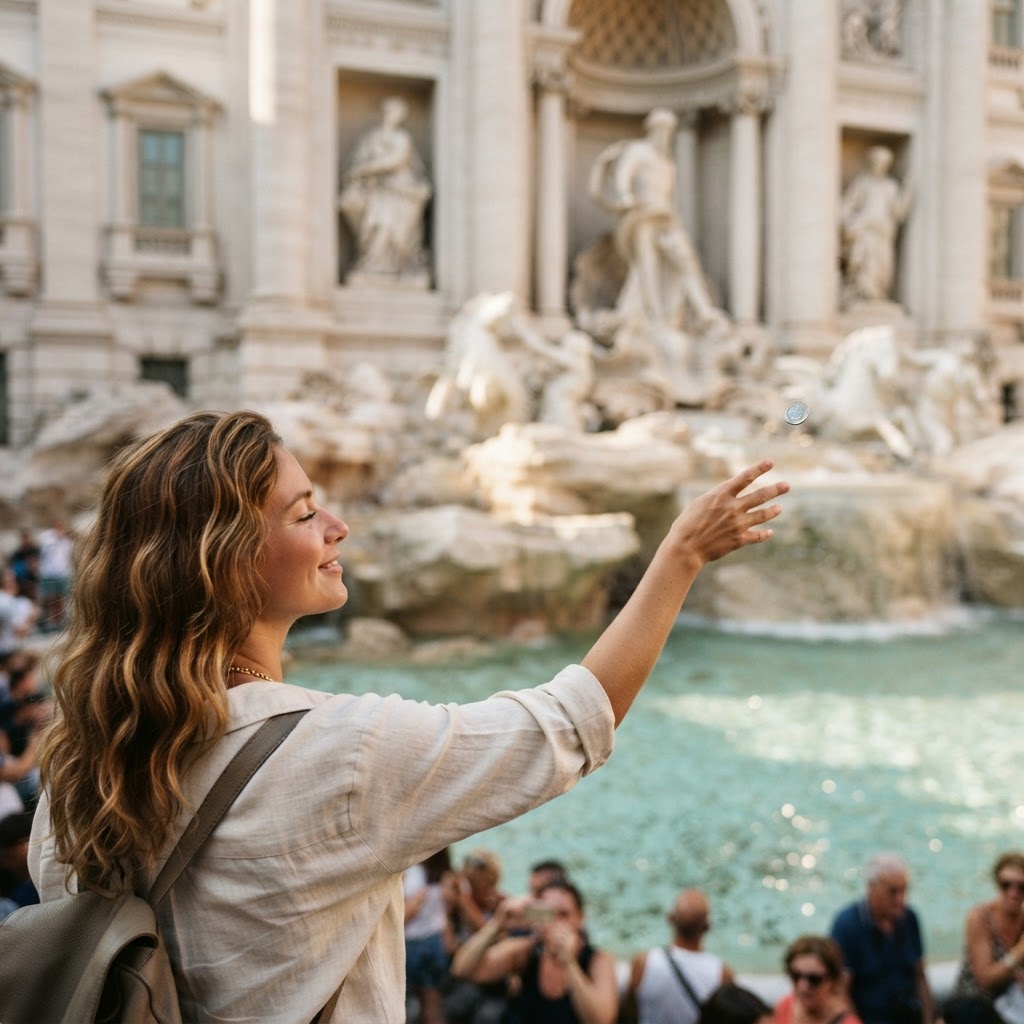
Trevi Fountain & Rome Highlights Walking Tour
Toss a coin at the Trevi Fountain, then walk to the Pantheon, Spanish Steps and Piazza Navona with a guide.
Book on GetYourGuide
Vatican Museums, Sistine Chapel & St. Peter's Basilica Guided Tour
Skip the lines and see the highlights of the Vatican with an expert guide.
Book on GetYourGuide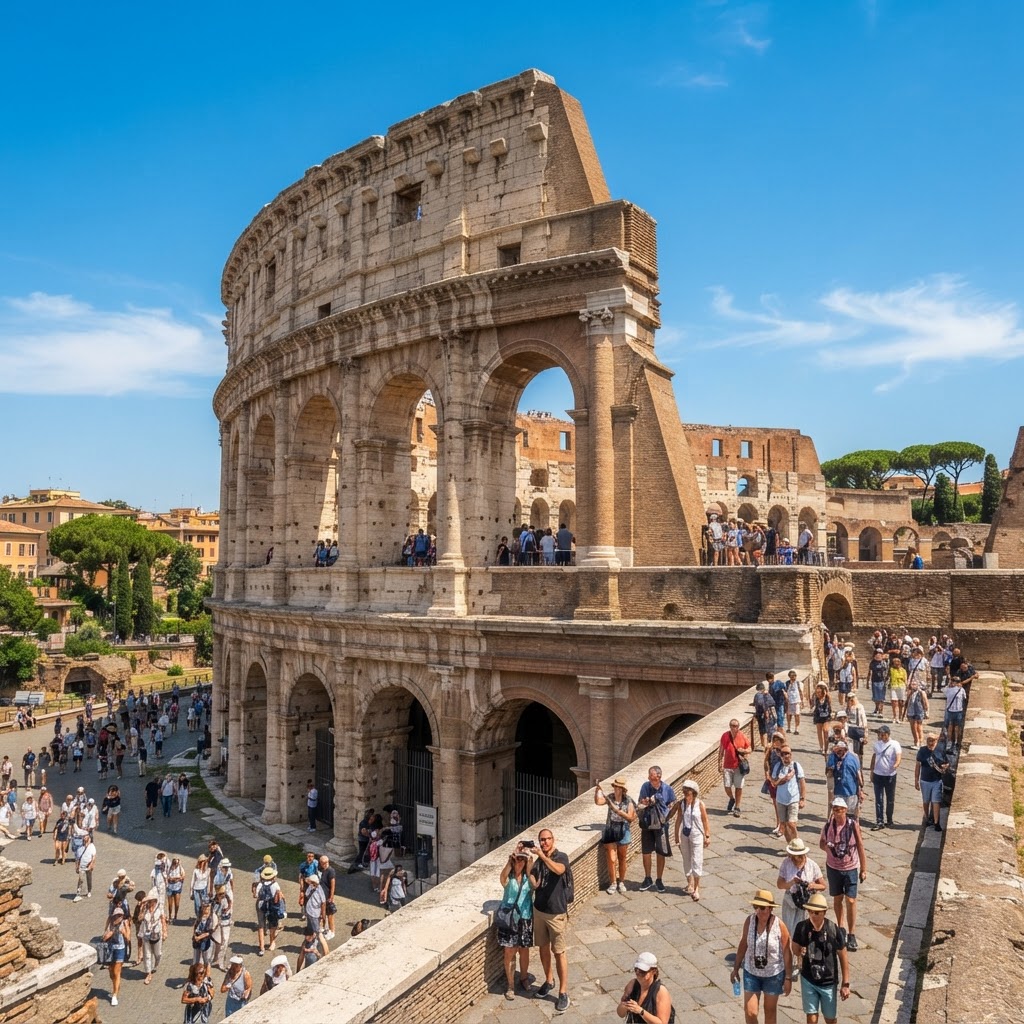
Rome: Colosseum, Roman Forum & Palatine Hill Guided Tour
Step into ancient Rome with skip-the-line entry and an expert archaeologist guide.
Book on GetYourGuide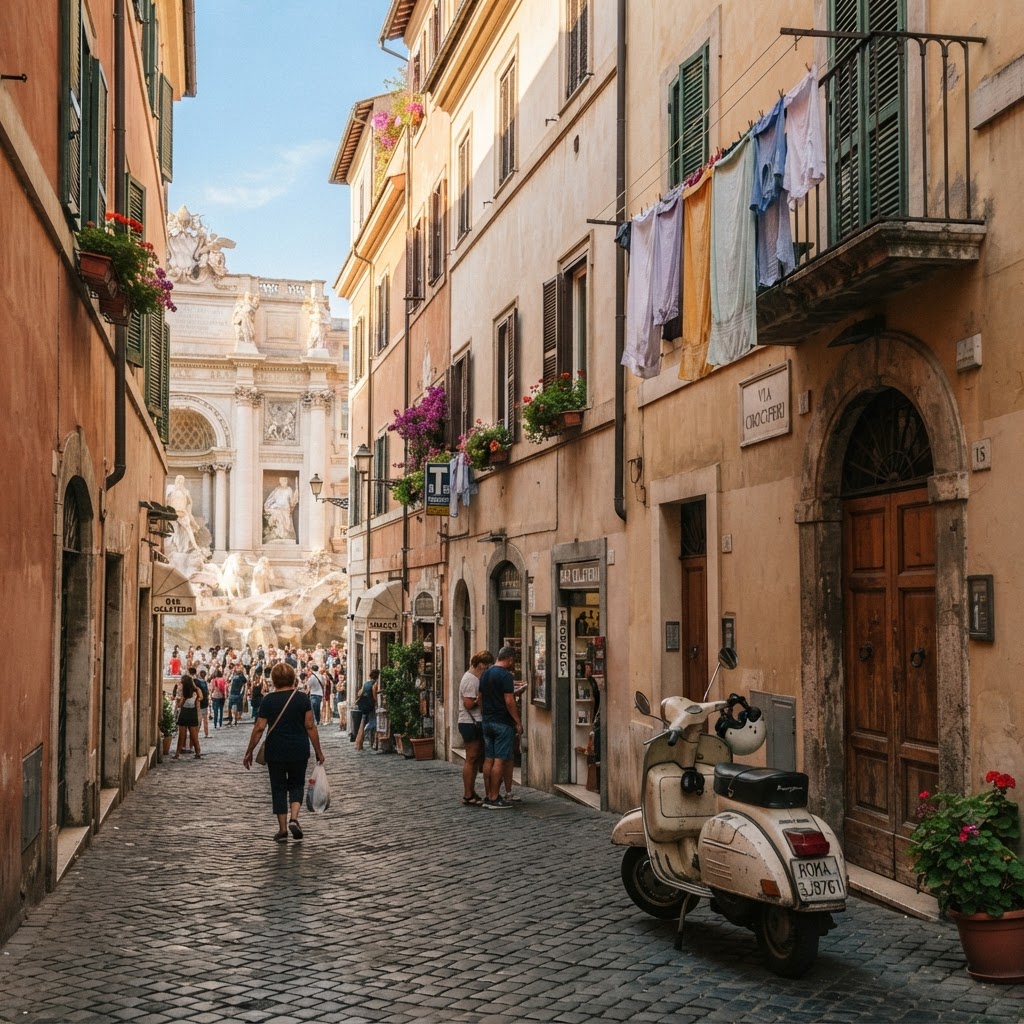
Rome: Food Tour in Trastevere
Taste your way through Rome's foodie district on a guided evening walking tour.
Book on GetYourGuideThe Trevi Fountain in Pictures
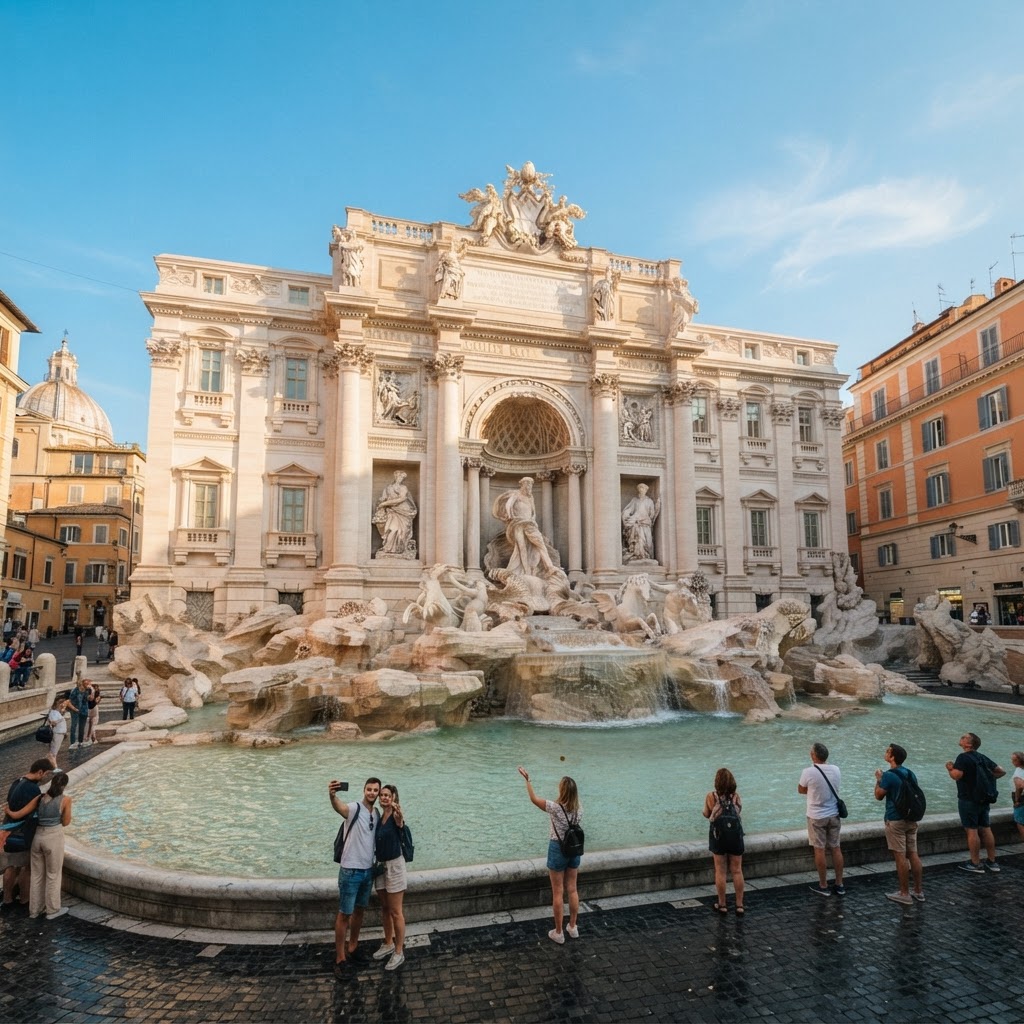
From the coin toss at dawn to the floodlit fountain at night, here is a visual tour of the Fontana di Trevi to inspire your visit.

Frequently Asked Questions
Why do people throw coins in the Trevi Fountain?
According to legend, throwing a coin into the Trevi Fountain over your left shoulder while facing away from the water guarantees that you will one day return to Rome. Throw two coins and you are promised a new romance, three and you will marry. The tradition became famous through the 1954 film 'Three Coins in the Fountain' and is now one of the most beloved tourist rituals in the world. Around 3,000 euros are tossed in every day, and the city collects and donates them to Caritas, the Catholic charity that feeds and shelters the poor of Rome.
Is the Trevi Fountain free to visit?
Yes. The Trevi Fountain is a public monument in an open piazza and there is no entry fee or ticket. It is accessible 24 hours a day, all year round. The only cost is the optional coin for the traditional toss, and you can spend as long as you like admiring the fountain. It is illuminated at night, making an evening visit one of the most popular free things to do in Rome.
What is the best time to visit the Trevi Fountain?
The best time to visit is early in the morning, ideally before 8:00am, when the piazza is quiet, the morning light is warm and the water is calm. The fountain is also magical after dark, when the floodlights come on and the crowds thin out. Avoid the middle of the day, especially between noon and 4:00pm, when tour groups and day-trippers pack the small piazza. Weekday mornings in spring and autumn are the sweet spot for mild weather and the smallest crowds.
How do I get to the Trevi Fountain?
The Trevi Fountain stands in the Piazza di Trevi, in the heart of Rome's historic centre. The nearest Metro station is Barberini on Line A, about a 5-minute walk away. Buses 62, 63, 80 and 175 stop nearby on Via del Corso. From the Pantheon the fountain is a 10-minute walk, and from the Spanish Steps about 7 minutes on foot. Taxis and rideshares cannot reach the narrow piazza itself but can drop you at the start of Via delle Muratte, a short walk away.
Can you swim in the Trevi Fountain?
No. Entering, bathing in or wading into the Trevi Fountain is strictly forbidden, and fines for doing so run into hundreds of euros. The fountain is a protected monument and an active public water feature fed by an ancient aqueduct. You may toss coins from the edge, but reaching in to retrieve them or touching the water is also not allowed. The city police patrol the piazza, especially during the busy daytime hours.
Who built the Trevi Fountain?
The Trevi Fountain as we see it today was commissioned by Pope Clement XII in 1732. The Roman architect Nicola Salvi won the design competition and worked on the fountain for 30 years, but he died before it was finished. It was completed by Giuseppe Pannini in 1762. The central statue of Oceanus was carved by Pietro Bracci, and the whole structure is built into the rear wall of the Palazzo Poli, a noble Roman palace, which is why the water appears to pour from the building itself.
How long should I spend at the Trevi Fountain?
Most visitors spend about 15 to 30 minutes at the Trevi Fountain, enough time to admire the statues, toss a coin and take photographs. If you arrive early before the crowds, you may want to linger longer. The fountain is small and the piazza is tiny, so it is easy to combine with the Pantheon, the Spanish Steps and the Quirinale Palace in a single morning walk through the historic centre.
What does the Trevi Fountain represent?
The Trevi Fountain celebrates the Acqua Vergine, the ancient aqueduct built in 19 BC that still feeds the fountain today. The central statue is Oceanus, god of all waters, standing in a shell chariot pulled by seahorses guided by Tritons. One horse is wild, the other calm, symbolising the two moods of the sea. Statues of Abundance and Health flank the central niche, representing the benefits that fresh water brings to the city. It is the supreme masterpiece of the Roman baroque.
Plan Your Visit to the Trevi Fountain
The Trevi Fountain is more than a monument, it is a wish, a legend and one of the most beloved sights in the world. Toss your coin at dawn, return after dark to see it floodlit and almost empty, and let the baroque cascade carry you back to the Rome of Fellini and the popes. With a little planning and the right tours, flights and hotels booked ahead, your visit to the Fontana di Trevi will be the highlight of any trip to the Eternal City.
Keep Exploring Rome
Best Places to Visit in Rome
The complete Rome travel guide — where to go, when to visit and how to book.
St Peter's Basilica Rome Guide
Tickets, the dome climb and what to see at Christendom's grandest church.
Emirates Dubai to Rome Flight Price
The cheapest months and booking window for flying Emirates from Dubai to Rome.